Join the
Future Ready Community
At Future Ready Consulting, we believe that growth and innovation thrive in the community. Whether you're an entrepreneur just starting out, a business leader looking to scale, or simply someone passionate about learning and adapting to the future, our community is the place for you.
Start your journey with us by following our blog for the latest insights, subscribing to our YouTube channel for expert tips and tutorials, and connecting with us on social media for real-time updates and conversations. Join a network of like-minded individuals and organizations who are committed to driving change, embracing new opportunities, and preparing for the future. Engage with us, share your journey, and let’s grow together. Your future-ready path starts here.
Is Your Program Portfolio Still Built for This Labor Market?
There's a pattern I see in almost every continuing education unit I work with, regardless of size or institution type.
They have programs that have been running for years...some for decades. A few are thriving. Several are limping along, sustained more by inertia than demand. And somewhere in the portfolio is a gap: something the labor market is clearly asking for that the institution isn't yet offering.
The problem isn't that CE leaders don't want to fix this. It's that they don't have a reliable way to see it clearly from the inside.
Why Portfolio Inertia Is So Hard to Spot
When you've been running a program for five years, it becomes part of the infrastructure. Faculty are attached to it. Students are enrolled. It generates some revenue. Canceling it creates friction you don't always have bandwidth to manage.
So programs stay. Even when enrollment is declining. Even when employer interest has shifted. Even when a newer credential type would serve the same learner better.
The 2026 State of Continuing Education research put numbers to something I'd been observing anecdotally: enrollment in online and professional continuing education programs has reached some of its lowest points in recent years. Some of that is environmental. But some of it is portfolio mismatch, programs designed for a labor market that has moved on.
The units pulling back on microcredentials and badges right now are often doing so for exactly this reason: they don't have the data to defend building new offerings, so they're not building them. But not building new things while enrollment declines on old things isn't a safe middle ground. It's a slow squeeze.
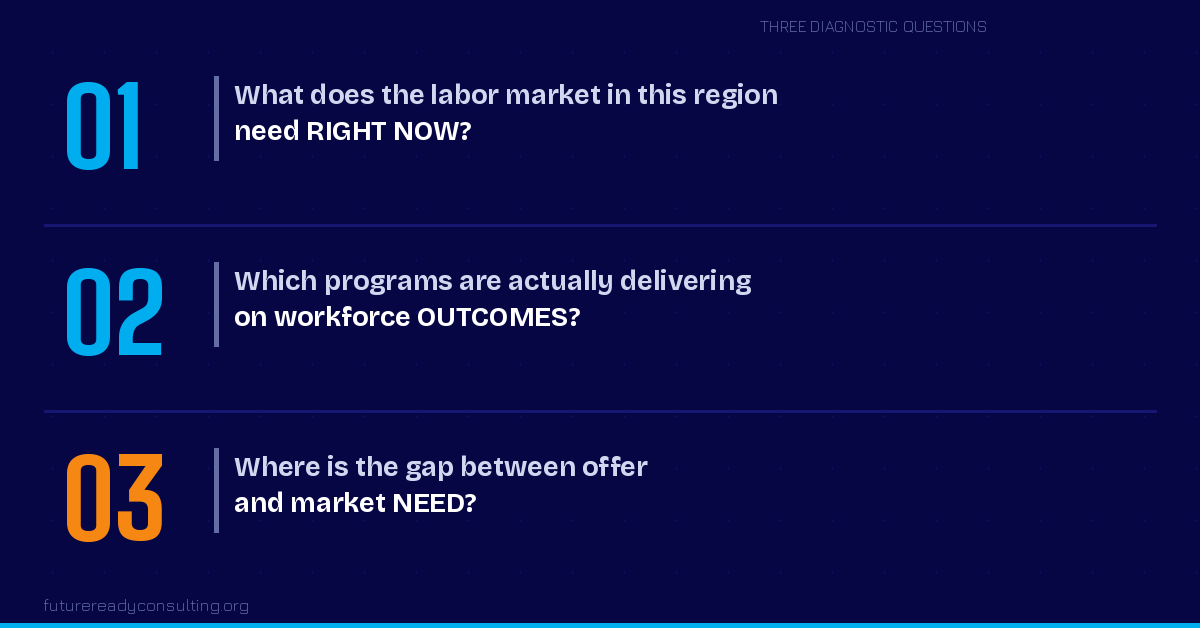
The Three Questions a Portfolio Audit Has to Answer
When I work with CE leaders on their program mix, I focus on three questions that most internal reviews don't actually get to:
1. What does the labor market in this region actually need right now?
Not what it needed three years ago when these programs were designed. Not what IPEDS data suggests nationally. What are employers in this area hiring for, what skills are emerging in job postings, and where is the credential gap that a well-designed program could fill?
Without real labor market intelligence — current, local, and specific — you're answering this question with educated guesses. And educated guesses, however well-intentioned, produce portfolios that don't quite fit the market they're supposed to serve.
2. Which of our existing programs are actually delivering on workforce outcomes?
This is where most CE units hit a wall. The data systems that track enrollment are often entirely disconnected from the data that would tell you what happened to learners after they completed. Did they get the job? The promotion? The credential that made the difference?
Without that connection, you can't answer the question honestly. And if you can't answer it honestly internally, you certainly can't answer it for an employer, a funder, or a provost.
3. Where is the gap between what we offer and what the market is asking for?
This is the opportunity question and it's usually more interesting than the other two. In most portfolios I've looked at, there are one or two clear demand signals the institution hasn't yet responded to. Emerging occupations with no credential pathway. Skills gaps that employers are vocal about but no local program addresses. Learner populations whose schedules or budgets don't fit existing formats.
Seeing the gap clearly is what makes building the right thing possible.
What Happens When You Start With the Data
The CE leaders I've seen move with the most confidence on their portfolios are the ones who start the conversation differently. Instead of asking "which programs should we cut?" ,a painful, political question that usually produces more defensiveness than clarity, they ask "what does the market actually need from us right now?"
When you have real labor market data to anchor that conversation, it changes. It becomes less about defending existing programs and more about aligning the portfolio with demonstrated demand. Programs that aren't matching that demand become easier to retire ,not because you want to cut them, but because the evidence points somewhere else.
And new programs become easier to propose, because they're built on something you can point to, not just a hunch.
A Note on Timing
This matters more right now than it might have a few years ago. Workforce Pell is creating a genuine opportunity for CE units that have the right programs and the infrastructure to support them. Employers are more focused on skills and credentials than they've been in a long time. Adult learners are looking for pathways that actually connect to their career goals.
But none of that opportunity accrues to a program portfolio built for the last decade's labor market.
If it's been more than two or three years since you've done a serious look at what your portfolio actually matches in the current market, it's probably time.
At Future Ready , we work with CE and workforce leaders to do exactly this kind of analysis: grounded in real labor market data, structured around the questions that matter for your institution. If you'd like to talk through what that looks like, I'd be glad to connect.

Future Ready Podcast
Check out our new podcast, Journey to Impact! Find it on YouTube and other popular podcasting services such as Audible.com!
Future Ready YouTube Channel
Want to learn more about business, tech, WorkStyle Patterns®️ Process, HighLevel? Then check out our YouTube Channel!
Online Communities
Become a member of one of our growing communities.
Learn from our experts and peers.
Get exclusive resources just for community members.
Get first access to any new courses.
In this community we explore all things Google. From Google Business Profile to Gemina to Docs and Sheets and more.
Learn about the lates updates to GoHighLevel and how to set up your business on the best software available.
Cincinnati, OH, 45215
Phone: (513) 995-2330
Copyright 2026. Future Ready Consulting. All Rights Reserved. Privacy Policy