Three Data Gaps Keeping CE Leaders From Making Their Case
Here's a tension I see playing out across continuing education units right now, and it's worth naming directly.
On one side: real momentum around workforce alignment. More employers want to work with institutions. Workforce Pell is creating new funding pathways. Learners are increasingly interested in credentials that connect directly to career outcomes. The environment for workforce-aligned CE programs is, in many ways, better than it's been in years.
On the other side: most CE units don't have the data infrastructure to capitalize on it.
They can't show employers the outcome evidence that would build trust and deepen partnerships. They can't show their provost a clean line between CE programs and regional labor market needs. They can't meet the reporting requirements that Workforce Pell demands, at least not yet.
The ambition is there. The data isn't.
The Three Layers of the Data Problem
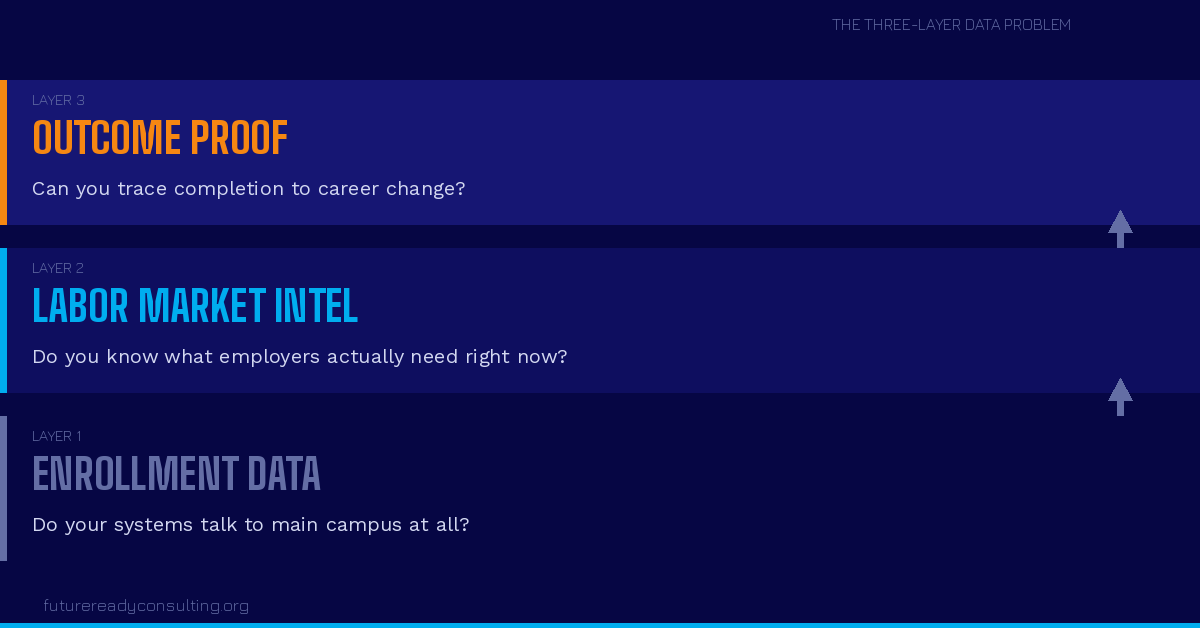
In my work with CE and workforce leaders, I've come to think of the data problem as three distinct layers, each one blocking the layer above it.
Layer 1: Enrollment data that doesn't integrate
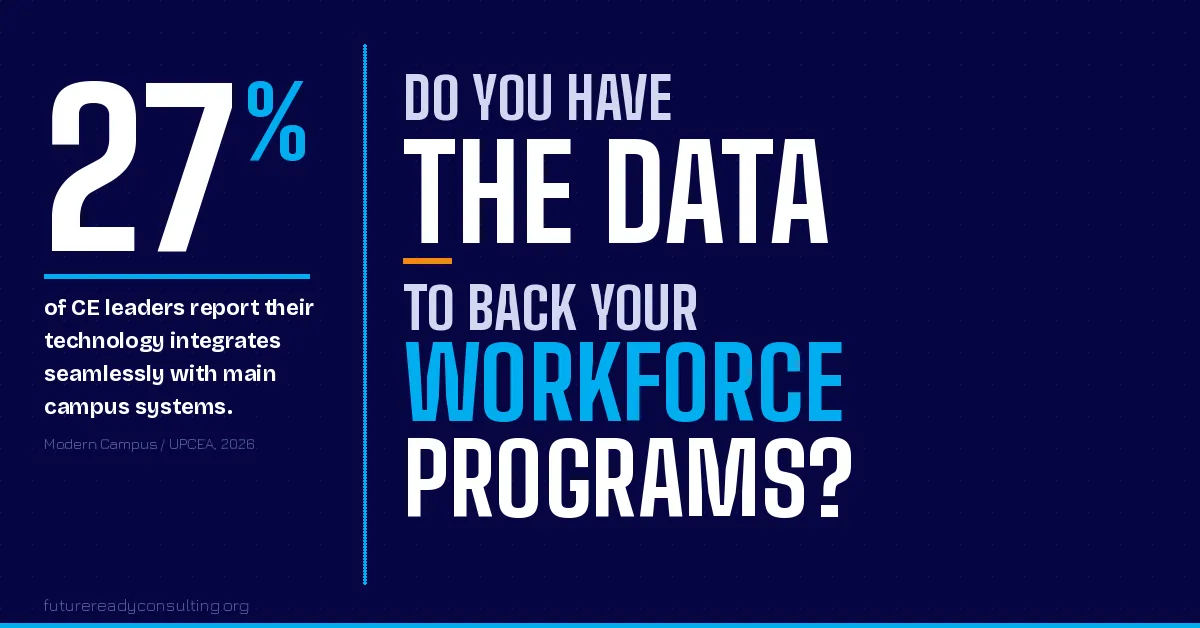
Only 27% of continuing education leaders report that their technology integrates seamlessly with main campus systems, according to the 2026 Modern Campus / UPCEA State of Continuing Education research. That number has been declining, not improving.
This means that even the basic act of knowing who is enrolled, where they came from, and what they're completing is harder than it should be. Reports have to be pulled manually. Systems don't talk to each other. Real-time visibility into enrollment trends is limited for most units.
That same research also points to something worth noting: institutions that have moved to a purpose-built CE student information system, one designed from the ground up for noncredit and workforce learners rather than retrofitted from a traditional SIS, tend to close Layer 1 faster. Modern Campus Lifelong Learning is one of the few platforms built specifically for this population. But even institutions on the right technology still have to do the deliberate analytical work to connect enrollment visibility to the layers above it.
If you can't see clearly what's happening inside your own programs, the problems in the next two layers become much harder to solve.
Layer 2: No labor market intelligence for program decisions
CE leaders are making consequential decisions (what programs to build, what credentials to offer, what to retire) without reliable data about what the regional labor market actually needs.
The workaround most units use is some combination of peer benchmarking (what are similar institutions doing?), employer anecdote (what did that employer say at the advisory board meeting last spring?), and professional intuition built over years in the field.
That's not nothing. Experienced CE leaders develop real judgment about their markets over time. But it's also not sufficient anymore, not when employers are asking for evidence of labor market alignment, not when Workforce Pell requires demonstrating that programs lead to gainful employment, and not when enrollment is under pressure and the cost of a wrong program decision is high.
Layer 3: No way to prove outcome connections
The deepest layer of the data problem is also the most politically charged: CE units generally can't trace a clean line from program completion to employment outcome.
"Proving that a specific credential directly caused a raise, promotion, or job change is inherently difficult," one UPCEA report noted recently. "Career trajectories are shaped by many variables; causality is messy at best."
That's true. And it's not an excuse to stop trying. Because the inability to prove outcome connections is exactly what keeps CE units in a defensive posture with institutional leadership, employers, and funders. It's what makes the "61% feel undervalued" statistic real: without outcome proof, the case for investment in CE is always partially built on faith.
Why This Matters More Right Now
Workforce Pell is clarifying something that has been true for a while but easy to defer: the institutions that will capture workforce funding and employer partnership opportunities going forward are the ones that can demonstrate outcomes. Not describe them. Demonstrate them.
The data requirement isn't going away. If anything, it's getting more demanding: from federal reporting standards, from employers who want evidence before they invest in partnerships, from institutional leadership that is increasingly focused on return on investment.
The 42% of CE leaders who say they're not prepared for Workforce Pell data requirements aren't all starting from zero. But they are starting from behind. And the gap between where their data infrastructure is and where it needs to be is a gap that takes time to close.
What Different Data Infrastructure Actually Enables
This isn't just about compliance. The CE units I've seen make the most progress on recognition, resources, and employer relationships are the ones that have done the hard work of solving for data first.
When you can walk into a leadership meeting and say: "Here's what the labor market in our region is asking for, here's how our program portfolio matches it, and here's what happened to learners who completed our programs last year": the conversation changes. You're no longer defending CE's existence. You're making the case for what it can become.
That's a different position to be in. And it starts with getting the data right.
At Future Ready, we work with CE and workforce leaders, and alongside partners committed to the same shift, including Modern Campus, to connect the dots: labor market intelligence, program portfolio analysis, and outcome framing that moves you from data gaps to a case you can make with confidence. If you're working through the data problem at your institution, I'd be glad to talk through what that looks like.
